When One Company Controls Everything, Who Controls Your Pharmacy?
Independent pharmacy owners face a landscape where software vendors increasingly control operational decisions through closed ecosystems and vertical integration.
Independent pharmacy owners have never expected the road to be easy. For decades, they have operated in an environment shaped by forces largely outside their control — reimbursement rate changes, PBMs (pharmacy benefit managers) constantly in their pockets, and regulatory requirements that make it feel impossible to run their businesses. Competitive pressures emerge from new directions. Success has always required a combination of adaptability, resilience, and an unwavering commitment to serving patients despite the obstacles placed in front of them.
Yet through all of those challenges, one advantage has remained at the heart of independent pharmacy: the ability to make independent decisions.
Freedom to Evaluate Opportunity
That independence is about far more than ownership, and it is more than having your name on the building. True independence is the freedom to evaluate opportunities, negotiate relationships, and make business decisions based on what is best for your pharmacy, your staff, and your patients. That freedom has always been one of the most valuable assets an independent pharmacy possesses and one of the reasons independent owners decided to open their own pharmacy to begin with. But sometimes choice is one of the easiest assets to surrender without realizing it.
In the beginning, pharmacy management software occupied a relatively straightforward role. Pharmacies selected systems based on functionality, workflow efficiency, support, reliability, and cost. The software was a tool. It performed a necessary function and helped pharmacies operate more effectively. Beyond that, the relationship was generally uncomplicated. Today, the landscape looks very different.
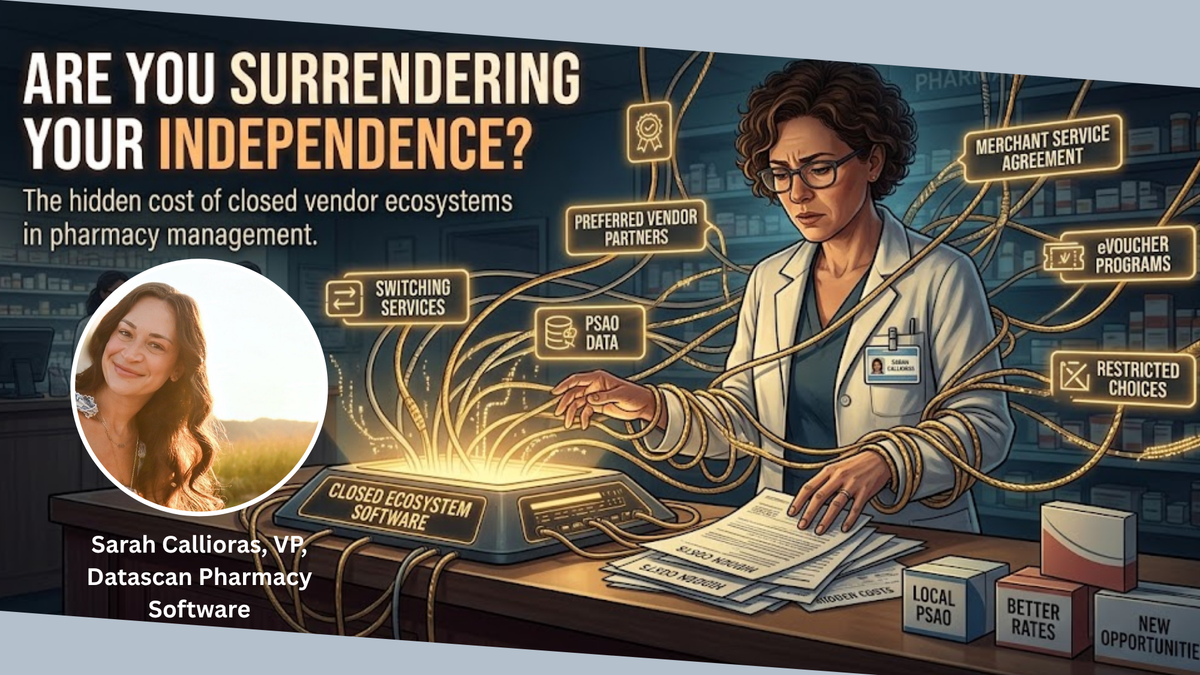
Across the industry, there are fewer independently owned pharmacy software vendors, as more and more continue to sell off and merge, owned under a giant private equity-backed umbrella. Many now sit at the center of larger ecosystems that may include switching services, network relationships, merchant service agreements, and third-party applications like delivery systems. These expanded offerings are often presented as opportunities to streamline operations and cut costs, but do they really save the pharmacy money? Are they really offering anything better?
The Value in Options
Every successful business owner understands a fundamental truth about leverage: Leverage comes from having options, and those options help independent pharmacies find profits in a difficult market.
A pharmacy may not immediately recognize when their choices are no longer theirs, but instead are made by their software vendor. In fact, it often happens gradually. Additional services become connected. Relationships become intertwined. Operational dependencies increase. What begins as a simple software decision can eventually influence other areas of the business that were once independent choices.
The concern is not that integration exists — integration can create meaningful benefits. The concern is whether pharmacy owners fully understand the tradeoffs that may accompany those benefits.
Most pharmacy owners can identify moments in their careers when circumstances required a significant shift in strategy. Market conditions changed, reimbursement pressures intensified, and new partnerships became available. Existing relationships no longer produced the value they once did. Those moments are precisely when options become most valuable. A pharmacy that retains flexibility can adapt, and a pharmacy with multiple alternatives can negotiate. By contrast, a pharmacy that finds itself deeply connected to a single ecosystem may discover that changing one relationship affects several others. The ability to choose vendor partners that benefit your business is no longer an option. These decisions are being made for you, whether they benefit you or not.
One company is increasingly steering pharmacies toward a closed ecosystem of preferred vendor partners. While these partnerships are often marketed as streamlined solutions, they can significantly limit a pharmacy’s ability to choose the vendors and services that best support its business. As the owner of a switch, the company has a clear incentive to direct customers toward its own network and affiliated partners. But what does that mean for independent pharmacies? It means losing access to eVoucher programs that have historically reduced patient costs while generating additional revenue for the pharmacy. It means the PSAO (pharmacy services administrative organization) that you carefully selected may no longer receive critical claims data from the switch, limiting visibility and potentially impacting performance. It means the credit card processor you chose for its competitive rates may no longer integrate with your point-of-sale system, forcing you into less favorable alternatives. These changes are often presented as conveniences designed to simplify operations, but in reality, they can reduce flexibility, restrict competition, and limit a pharmacy’s ability to make independent business decisions. The result is an ecosystem that increasingly benefits the company’s bottom line, while pharmacies surrender control over key aspects of their operations.
Those considerations matter because healthcare continues to experience rapid consolidation. Across virtually every sector of the industry, organizations are expanding vertically, acquiring complementary services, and building increasingly comprehensive platforms. From a corporate perspective, these strategies often make perfect sense. Larger ecosystems can create efficiencies, increase market influence, and strengthen competitive positioning. The question independent pharmacy owners must answer is whether those same strategies always align with the long-term interests of independent pharmacy. As more services become concentrated under fewer organizations, are pharmacy owners gaining options or losing them? Every pharmacy operates under different circumstances, serves different communities, and faces different business realities. What works for one pharmacy may not work for another.
That is precisely why maintaining the freedom to choose remains so important.
Remain in Control of Your Future
The future will undoubtedly bring new challenges. It will also bring new opportunities. The pharmacies best positioned to navigate that future will not necessarily be those attached to the largest vendors, but will be the pharmacies that retain the ability to evaluate opportunities on their own terms and make decisions based on their own priorities. Most importantly, pharmacy owners should remain in control of the decisions that shape their future.
Every pharmacy owner should periodically step back and take an honest look at the relationships surrounding their business. Not with fear and not with suspicion, but simply with the same business discipline they apply to every major decision. Because independence is not merely about ownership; it is also about preserving the power to choose — and in an industry where change is constant, that power may be one of the most valuable assets an independent pharmacy can protect. PTMR
Sarah Callioras, VP of Datascan Pharmacy Software, leverages her extensive industry experience to drive product innovation and client success. Dedicated to the advancement of pharmacy technology, Sarah focuses on delivering intuitive, high-impact solutions that empower pharmacists to streamline operations and enhance patient care. She can be reached at sarah@datascanpharmacy.com.