How Automation Redirects Staff Toward Patient-Focused Care
By leveraging automation and operational metrics, organizations can reduce manual, task-based efforts and redirect staff toward higher-value, customer- and patient-focused activities.
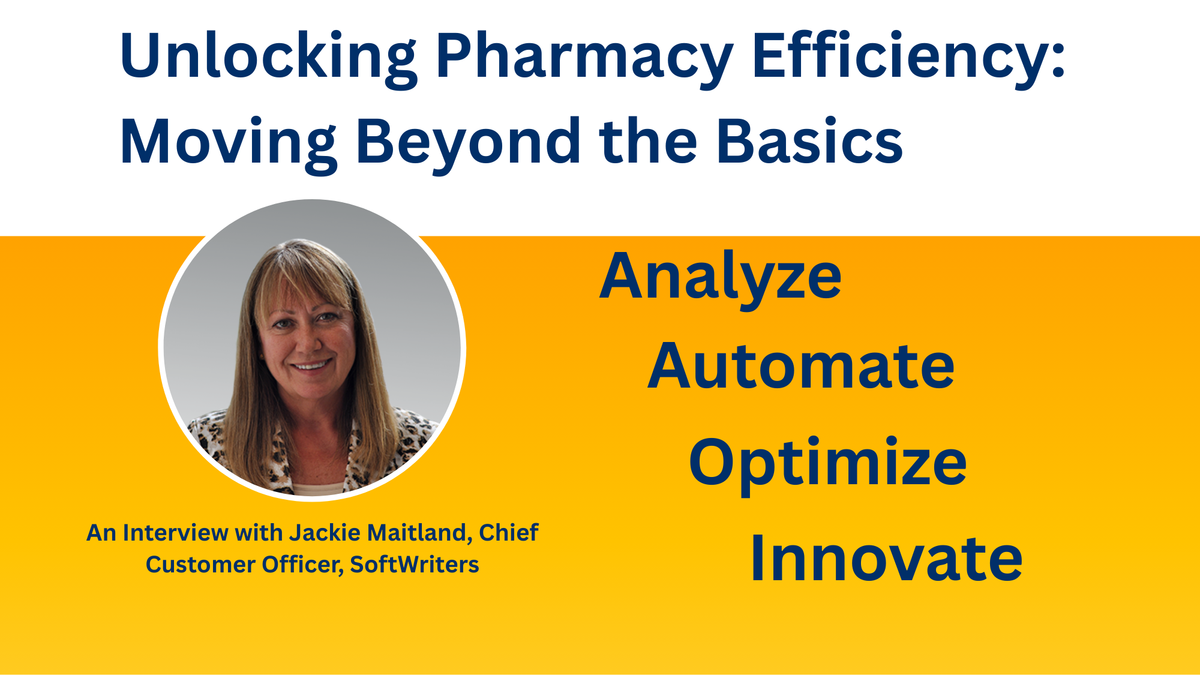
PTMR’s Maggie Lockwood asked Jacqueline Maitland, chief customer officer at SoftWriters, how pharmacy management systems provide sophisticated resources that drive efficiency and better outcomes.
PTMR: Are pharmacies getting beyond basic reports and using sophisticated dashboards to analyze trends in operations, inventory turnover, cost savings, or financial performance?
Jackie Maitland: Pharmacies are increasingly moving beyond basic reporting, though adoption varies. Many organizations are using dashboards and trend-based analytics to better understand both financial and operational performance over time — such as inventory utilization, workflow volumes, exception rates, and turnaround times. When reviewed consistently, these insights help leaders make informed decisions about where to focus attention and resources.

As technology capabilities continue to evolve, pharmacies are also rethinking how work is performed and who performs it. By leveraging automation and operational metrics, organizations can reduce manual, task-based efforts and redirect staff toward higher-value, customer- and patient-focused activities. This shift isn’t just about improving financial performance — it’s about driving operational efficiency, scalability, and better outcomes while enabling teams to focus on work that requires clinical judgment and human engagement.
PTMR: How can pharmacies fine-tune automated workflows for specific tasks?
Maitland: Pharmacies fine-tune automated workflows by aligning technology with how work actually moves through the organization. Effective automation starts with clearly defined processes and ownership, then leverages system-embedded workflow capabilities to route tasks, manage exceptions, and ensure accountability.
Capabilities such as role-based routing, automated document handling, and rules-driven workflows reduce manual touchpoints while maintaining visibility and control. That visibility is critical, particularly in highly regulated long-term care environments. A high-quality system of record — such as a pharmacy management platform like FrameworkLTC — should also provide comprehensive tracking and logging of all data movement across the platform. That audit trail must be secure, transparent, and protected from manipulation, giving pharmacy leaders confidence in both daily operations and regulatory readiness.
The most successful organizations continuously evaluate workflow performance, adjusting automation as volumes shift, services expand, or compliance requirements evolve. When workflow technology functions as an operational framework rather than a simple task engine, it becomes a powerful driver of efficiency, consistency, and scalability — allowing teams to stay focused on patient care instead of audit concerns.
PTMR: Are pharmacies fully leveraging the compliance and documentation capabilities embedded within their pharmacy management system?
Maitland: Yes. Many pharmacies are actively leveraging the compliance and documentation capabilities built directly into their pharmacy management systems to support regulatory requirements and patient care. These capabilities operate at the pharmacy, facility, and patient level, helping standardize workflows, reinforce accountability, and reduce operational risk.
When embedded into daily operations, they enable consistent documentation, strengthen audit readiness, and support compliance without adding administrative burden. The most effective pharmacies treat compliance as an integrated part of operational execution — not a separate task — maintaining efficiency while ensuring patient safety across locations and care settings.
PTMR: With the operational and financial pressures pharmacies are facing in 2026, are they placing enough focus on high-impact areas like inventory management, given the significant role it plays in overall spend? Are pharmacies actively using the inventory management capabilities within their pharmacy management systems to manage stock effectively?
Maitland: Yes. In fact, while inventory consistently ranks among the top three cost drivers for pharmacies, we regularly see exemplary inventory turns as a point of pride among leading organizations. These pharmacies achieve strong financial and operational results by mastering the inventory management capabilities built directly into their pharmacy management systems — such as monitoring purchasing patterns, usage trends, and stock levels.
When these capabilities are embedded into daily workflows, pharmacies are better positioned to reduce waste, prevent shortages, and make informed purchasing decisions. The most successful organizations treat inventory management as a strategic discipline rather than a backoffice function, aligning cost control with patient care and service reliability.
PTMR: What advice would you offer other pharmacy leaders looking to leverage more advanced or AI (artificial intelligence)-enabled capabilities while ensuring responsible adoption and staff confidence?
Maitland: AI is shaping a new frontier in technology, and like any major innovation, it brings both opportunity and risk. Trust is paramount when evaluating AI for pharmacy operations. The reliability, safety, and security standards embedded in the technology architecture matter because AI accelerates outcomes — both positive and negative. The integrity of the architecture, underlying data, and quality controls ultimately determines how these systems perform.
Pharmacy management systems are investing heavily to embed advanced and AI-enabled capabilities directly into their platforms, ensuring critical audit logging, system tracking, and governance remain intact. When implemented responsibly, these capabilities reduce manual effort, improve consistency, and allow pharmacists and technicians to focus more time on patient care.
Patient safety must always come first. Pharmacy leaders should be intentional about how AI is introduced, with clear guardrails, governance, and ownership in place. The most effective approach is adopting AI within the systems that already manage core pharmacy workflows, data, and compliance requirements. This builds staff confidence, reduces operational risk, and ensures innovation supports — rather than disrupts — care delivery. Success ultimately comes from pairing innovation with trust, education, and disciplined execution. PTMR