Direct Access: Demystifying Pharmacy Discount Cards
An integration between Outcomes and Rx.co brings world-class, enterprise-class pricing strategy made available at scale to your local pharmacy.
Welcome to Pharmacy Technology & Management Review’s Direct Access video series, where we have the opportunity to hear from vendors about the new features and enhancements they’re bringing to the market to help keep pharmacies successful.
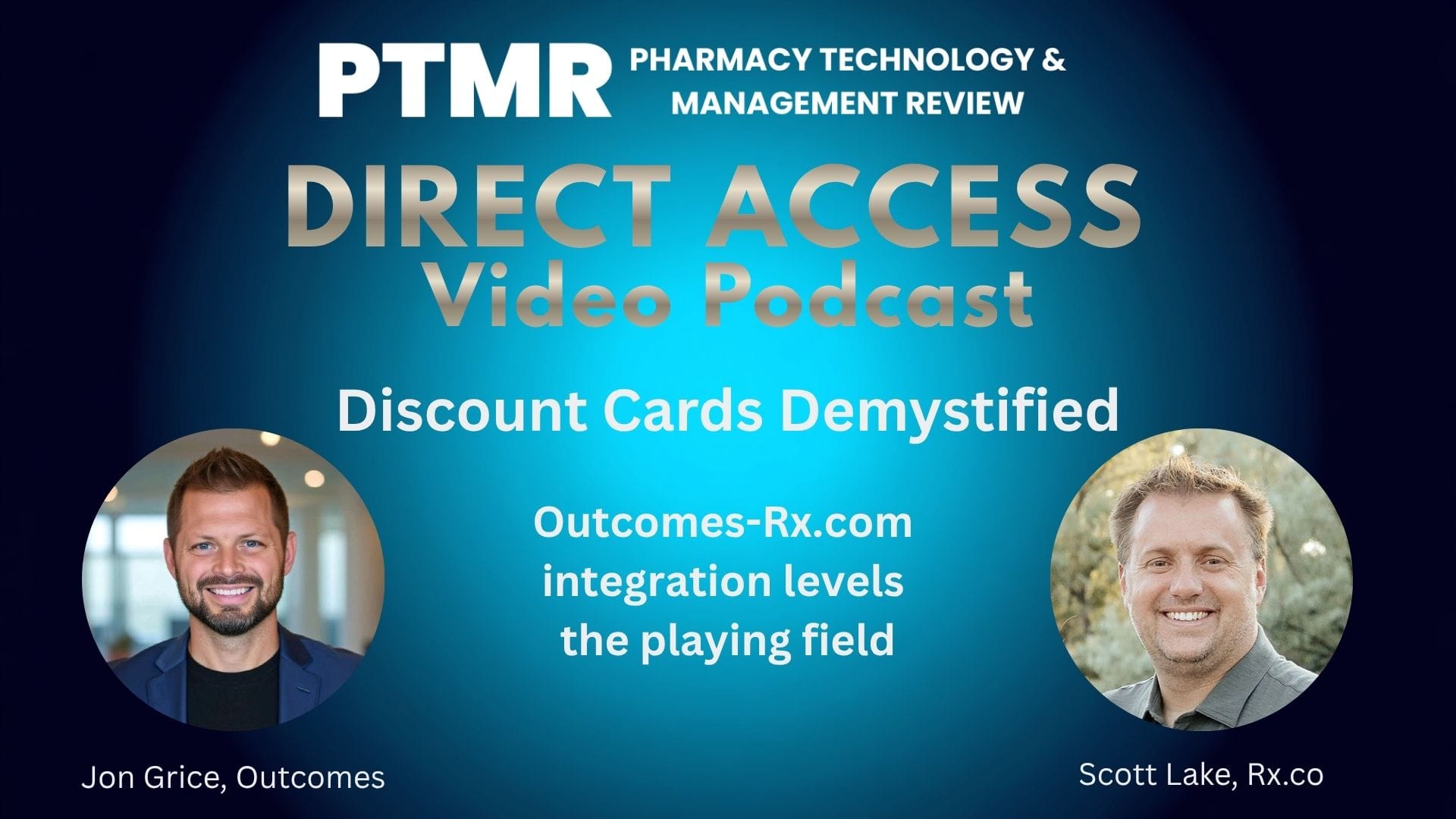
In this episode, PTMR’s Maggie Lockwood speaks with Jon Grice, VP of pharmacy insights at Outcomes, and Scott Lake, CEO and founder of Rx.co, on the recent integration between the two companies that will demystify the discount cards that pharmacists have to contend with on a daily basis.
Jon and Scott will explain how Rx.co Claims Manager addresses discount card pain points within the Rx30 and Computer-Rx pharmacy workflow and lay out the power of having data at the point of adjudication so that pharmacists know exactly how much they're going to be making based on cash pricing.
The bottom line for this integration: to provide transparent and fair pricing that benefits both the pharmacy and the customer.
PTMR: I want to welcome you both here today for our Pharmacy Technology & Management Review Direct Access video series. Jon, why don’t you begin and share a little bit about yourself and your background with Outcomes?
Jon Grice: I'm a pharmacist myself, I have been a pharmacy owner, and now I work as the vice president of pharmacy insights for Outcomes. I’m excited to be able to talk about this topic that we’re trying to address. Scott’s really built out a slick tool for a timely topic. I don’t know that five years ago this would’ve been as pressing of an issue, and hopefully five years from now it won't be an issue. But based on what we are able to see on the backend through the pharmacy insights that our stores are reporting, I think taking action on the discount card landscape is going to be really helpful right now.
Scott Lake: Thank you very much. We appreciate the invitation. I’m the CEO and founder of Rx.co. My background’s a little different. I am not a pharmacist; I am more of a pricing nerd, and I am really into data and pricing. I started in the pricing space when I was working at Priceline.com, where I ran the product data analytics team. The travel industry has some of the most sophisticated pricing people, and we like to think that we are at the forefront there. Everyone’s aware in travel that prices go up and down. While most people think about this in terms of a time series — meaning at one point in time, my flight is more expensive than another point in time — what people don’t realize is that starting around 2016, we started personalizing prices for people. We were able to see that certain people, in order to access a product, would need a deeper discount, so we would make that available to them. It’s a personalized discounting mechanism. Those with less ability to pay sometimes, not always, received the bigger discount.
After Priceline, I have since owned and operated four of my own independent pharmacies, two pharmacy-managed services organizations, as well as worked with pharmacies in the compounding space and helped pharmacies with workers' compensation. About two and a half years ago, I started looking at a way to help pharmacies manage the ever-growing cash problem. This is the focus of our business and the integration with Outcomes. The company is the intersection of my professional experience in pricing, data, and technology, as well as my relatively light background, but yet a background, in the pharmacy space.
Watch the entire video with John Grice (VP of Pharmacy Insights at Outcomes) and Scott Lake (CEO/founder of Rx.co) to discuss their new integration tackling pharmacy discount card pain points.
PTMR: What made you buy pharmacies?
Scott Lake: Funny enough, I was coming to the end of my time at Priceline looking for my next adventure, and I talked to my brother, who was in the pharmacy space. After talking with him, we decided to get into business together. He is still one of my partners and is a co-founder at Rx.co.
PTMR: When will the integration go live?
Grice: We are excited that the integration will be live this year. We have about 6,000 pharmacies that will benefit by having claims routed through this intermediary and being able to have their plan switched to address the "discount card phenomenon."
PTMR: Great. Let’s talk about why this integration is needed and how it will work.
Grice: When I was a pharmacist, I would look over 40 stores' dispensing, and so much of my time and energy was spent analyzing third-party contracts and basis points of percentages, trying to even audit my own third-party claims to make sure that they were paid at contract. And if they were, then I'd turn to the wholesaler to look for more margin and try to better my deal over there, all while dollars were just walking out the door in discount cards. I had at the time the Rx30 Outcomes pharmacy system, and it has always had really good cash pricing abilities. It has a sophisticated menu of options for how to set your cash prices on all of the drugs in the system.
Yet the rise of the adjudicated discount cards and the administration fees that came with those were draining margin. It was always difficult to get your arms around which cards are good and you can accept, and which ones you need to somehow not accept or offer alternatives to.
Scott, as a pharmacy owner, what made you look at discount cards first or so quickly? You didn't get wrapped up with all the usual stuff of the big contract analysis and then the wholesaler cycles. How did you zero in so quickly on discount cards?
Lake: Well, it was becoming a bigger and bigger problem. You want to support all of your patients, and some of your patients prefer cash-based pricing. Pharmacy discount cards are a core vector to make that happen and maintain your compliance with usual and customary pricing laws.
It's tough. Most pharmacy owners look at this — and rightfully so — as one of the biggest problems in the industry. And if they don’t think it’s the biggest problem in the industry, then they may not be aware of just how pervasive this problem is.
Right now, if you look at switch-level data, 41% of all commercial claims are being rejected and then diverted to a pharmacy discount card, and it returns back to the pharmacy with this DIR [direct and indirect remuneration] fee — this negative insurance reimbursement.
It's a cash-based price. Did the patient technically opt in to doing this? Probably somewhere in the fine print. Did they really? Not really. Is there a very large administrative fee? Absolutely. We actually believe this large problem is a large opportunity for pharmacies that address it appropriately.
And so I increasingly set aside my independent pharmacy ownership — I’m no longer an independent pharmacy owner — and decided to tackle this head-on, using my pricing background, which I did in my own independent pharmacies. We did okay for ourselves with all the complex analytics, and I don’t expect pharmacists, who really should be focusing on the clinical side, to become pricing experts.
We built this software to support pharmacy pricing objectives and sustainability. Pharmacy has to be profitable, and it also balances patient needs. We are seeing success with our client base who is using the software.
PTMR: Can you share an example?
Lake: There’s a local pharmacy in Utah that we’ve been working with. They have implemented their pricing objectives, and they were able to improve their generic effective rate by about 25% and their brand by about 15%, which is the difference between keeping your doors open and not.
As we kept developing the product, we got in touch with Outcomes, and they have been great, forward-thinking partners. I think you’re going to see, especially with the different innovations that are coming from Outcomes, that you’re going to see them growing in the industry with their impact.
Not just in the number of stores and doors that they’re supporting in their clinical software, but in the impact on the clinical side for the patient, as well as the pharmacy’s sustainability and profitability. It’s been a great partnership, and we are announcing this at RBC with Cardinal Health.
Going forward, pharmacists will see a very seamless experience. The goal ultimately between Outcomes and Rx.co is to eliminate this side of the complexity of the business. It is a full-time job for us here at Rx.co managing it. Why should it be a full-time job for the PIC [pharmacist in charge] or the director of pharmacy?
PTMR: This is a situation where the pharmacist — especially in a smaller community pharmacy — has to wear so many different hats, and this seems like a hat that would take up a lot of time based on the complexity of pricing and contracts. This is a solution that would give them confidence that they’re not losing money in yet another transaction in the pharmacy.
Lake: I mean, absolutely. It’s like you’re bleeding from all these different spots. We have to have layers upon layers of detection just to understand and identify these incidents for the pharmacy. Now, to be very clear, the pharmacy is in full control of their data. They can dig in as deep as they want. It’s their claims data. They can understand exactly what’s going on.
But at the end of the day, no PIC wants a claim to become a research project, especially when a claim has been denied by the PBM [pharmacy benefit manager] and it’s been diverted to cash. There’s no way of resolving that; you’re not going to get the insurance to pay. And so how do you resolve this in a consumer-driven, friendly manner to support cash pricing? Which is why we have helped them build rule sets.
When you look at the sophisticated chain pharmacies out there, they are usually managing to brand and generic effective rates — it’s averages and target pricing where they need to meet on average to keep their doors open. We have brought that same technology that’s implemented at chains to these independent pharmacies.
PTMR: Let’s talk about the integration and the workflow.
Grice: It’s so common to bill a claim, get a rejection, and then know that, well, it’s not an issue of prior authorization or benefits that I need to investigate deeper; it’s just a matter of cashing this one out and sending it down the line. When you do that, you want that cash price to be accurate. I don’t want to charge too low, or if it’s an old drug file, not have updated pricing on this drug file and put my pharmacy at risk. But I also don’t want to have a bad drug file price schedule somehow get attached and now I look like an unreasonable practitioner to the patient who’s standing there.
I want the patient to see a fair price, and even if they say, "Hey, it wasn't covered, I’m going to go home and price shop online somewhere," you still want the result to be, "I trust my local pharmacy. They were giving me a fair price all along. I’ll just go pick it back up."
That’s the goal in the pharmacy. I want to know that if the medication is not covered, and I have to cash it out, I just want a good, solid price. It’s a project to try to keep updated cash pricing on every file all the time. This option of having a discount card to bill to and trust that it’s always going to give me a solid, competitive cash price — that is a huge benefit.
PTMR: How will this look in the Rx30 and Computer-Rx workflow?
Scott Lake: We are working very closely with Jon and his team to make this as smooth and seamless as possible. We don’t need other screens; we don't need other steps in the dispensing process. The pharmacy sets up rules, and then we enforce those rules automatically.
A claim comes in, it gets diverted to a cash card. The pharmacy has its benchmark targets. For example, the National Association of Chain Drug Stores did a study, and it came out in 2020 saying that pharmacies need $12.40 on average above the product cost just to cover their overhead costs — pay their pharmacists, their technicians, the electricity.
We’ll often see pharmacies set cost-plus based on benchmarks, and we support those. Within milliseconds, the claim routes through Rx30 or Computer-Rx, routes through our system, and goes onto the switch. We detect these instances and are looking up the pharmacy’s stated rules, and we are comparing all of the competitive pricing in the area. We have a database of every NPI [National Provider Identifier] with all of their prices, and so we can see where your local competition is.
Jon says it — the patient needs a fair price. That’s absolutely true. But fair also includes the value you provide in personalized service as an independent pharmacy. There’s a reason they’re at your store and they’re not waiting in line at a large chain whose strategy is to make you wait in line so you go buy other stuff. You know, it’s a valid strategy. It’s their strategy, but yours is a little different. It’s a little more personalized service.
PTMR: Tell us how the costs associated with the discount card, or cash price, can benefit the pharmacy and the patient.
Lake: We are looking at all of the pharmacy’s network contracts to identify low administrative fee options. If the patient’s insurance comes back and it’s $15, and there’s a $9 administration fee — which is very common — the patient’s paying $15, and the pharmacy’s walking away with $6. The patient is paying you a very large administrative fee, and they may not be aware of that. You may have an option that’s $13 with a $2 administrative fee, which is better for all the parties involved. Our job is to automatically make that available to the pharmacy. In all of the notes of the claim, the pharmacies can see their options. They can select from those options and engage the patient in a wonderful experience.
This is built into the automatic adjudication flow for Rx30 and Computer-Rx customers. The pharmacist, the PICs, the directors of pharmacy, the pharmacy owners, whoever it may be, can go into an interface that is linked from the Rx30 and Computer-Rx portal and set their pricing rules. They can understand we really need to be making $15 a prescription because efficiency isn’t our goal — it's great service, and that costs a little bit more. They can set those goals, and we will understand those goals and help to find the patient the right price at the right time.
This is happening at the exact moment of adjudication — within that one second you get the claim back, we have done all of our work. It meets pharmacy pricing objectives, and it is also the right price for the patient.
When the patient's information is submitted, we can help identify those patients who need a little more of a discount versus others. The pharmacist doesn’t have to have that in mind as to what is the right price for that patient. We are pricing experts. We have dealt with personalized discounts before at a very large scale. And the funny thing is, as I talked about, I started in travel. The way travel works is very similar to how pharmacy works: a hotel has a rate called BAR, or best available rate, and every rate that you purchase is a discount to that.
Well, that sounds very similar to a usual and customary price, and then your discounts and your PBM contracts, your discount cards. It’s very functionally similar. We simply look at your existing available prices and help the pharmacy in real-time automatically select the right price for the right patient at the right time.
PTMR: This is another example — and, Jon, you might have thoughts on this too—about the value that technology brings to the operational side of pharmacy. I mean, clinical obviously is something we talk about all the time, but this is an excellent example of the business side of the pharmacy that’s so important.
Grice: 100%. What I like so much about this is it’s not building a solution that benefits one area but won’t be seen as a benefit to any other party. At Outcomes we have our independent clients using our pharmacy systems, but we work with everybody. We partner with the chains, with payers, with pharma.
This is a solution that everyone is going to benefit from. It’s just a matter of implementing a technology that is designed the right way, and that’s what I'm excited by.
PTMR: We’ve covered a lot. Is there anything you want to add?
Scott Lake: I think it’s important to note this feature is going to be made available for free to all Rx30 and Computer-Rx customers as part of the partnership with Outcomes. You’re able to go in and set your benchmark pricing. We have support staff on hand, and it will be communicated as we launch on how to receive assistance if you need it to set your pricing benchmarks and generic effective rates and so forth.
We plan to have a premium feature where we can go more in-depth and hands-on with your team to improve your pricing strategies. That announcement will be forthcoming. You’ll get direct access to our team. I came from Priceline; my CTO is from Priceline. I took two of the data engineers from the pricing team. I mean, we are very much in the pharmacy space, but we know the ones and zeros behind pricing and how to move things up and down and support retailer pricing strategy.
This is world-class, enterprise-class pricing strategy made available at scale to your local pharmacy.
PTMR: Jon, anything else?
Grice: I’m just excited this will put to rest any of those claims that get made sometimes about the independent, smaller pharmacies somehow being priced higher than others. And it’s going to be made available to all of the Outcomes customers for free, like Scott said. There’ll be opt-up additional features that they can purchase as add-ons, but the technology itself, and the stop-the-bleeding effect, is going to be seen by everybody.
PTMR: That’s a good point that people make assumptions about how much prescriptions will cost at the community pharmacy.
Grice: Well, it was, in my opinion, a myth in the first place. And like I said, it’s going to set the bar, or level that back out.
Lake: It’s absolutely true. We see in the data independent pharmacies tend to be a little underpriced relative to their larger competitors. We have that information available in this system, so pharmacies can see where their competitors are priced. I was meeting with a pharmacy owner last week and they saw they are priced at $8; the other independent pharmacy is at $4, and the big names are around $30. What's going on there? We talked about the complexities of their contracts, and here’s how to resolve it.
The bottom line for this integration is this: Pharmacies will see improved net revenue. Patients will have better experiences, including pricing experience. And it really is made possible because we’re just cleaning up such a big mess.
PTMR: Thank you for your time. This has been a great conversation. PTMR
📺 [Watch the Full Video Interview]