Unlocking Pharmacy Potential: How Data and AI Are Changing Long-term Care
Terry Dean talks about how SoftWriters developed a web-based, artificial intelligence (AI) software solution that’s setting a new standard for accessibility and scalability.
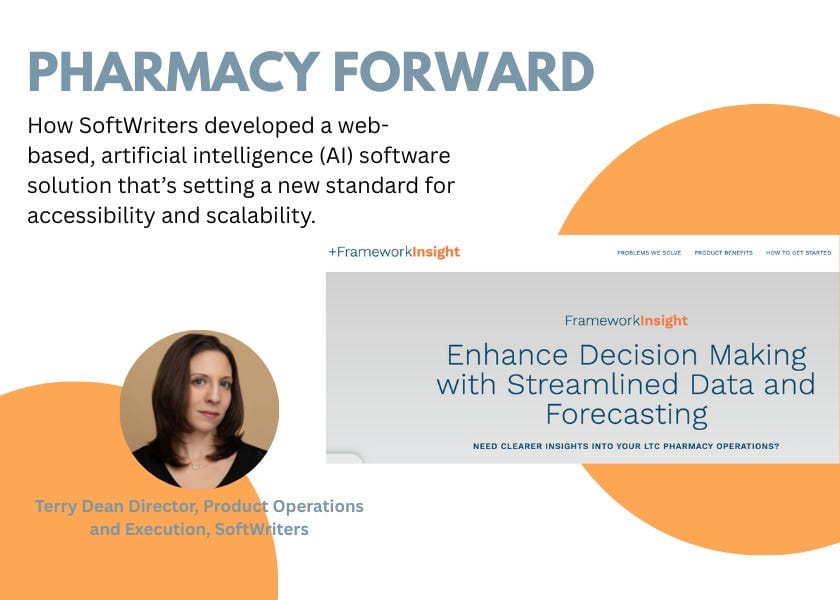
Terry Dean has been at the forefront of SoftWriters’ latest innovation. As the director of product operations and execution, she brings a unique perspective from her background in engineering and product roles, making her the perfect person to tell us about the company’s new product, FrameworkInsight. Join PTMR’s Maggie Lockwood as she talks with Dean about how SoftWriters developed a web-based, artificial intelligence (AI) software solution that’s setting a new standard for accessibility and scalability.
PTMR: Give us an overview of the development of FrameworkInsight.
Terry Dean: I’ve been excited to work on this new product that we brought to market this year. When we started, FrameworkInsight was born from the idea of trying to solve the problem for our customers where they need access to their data in a way that’s well organized, with actionable insights from their data.
Pharmacy Technology & Management Review is a reader-supported publication. To receive new posts and support my work, consider becoming a free or paid subscriber.
The question we wanted to solve is how our customers can keep up and make sure that the reporting is accurate and giving them the insights they need. So from the SoftWriters’ perspective, we went at it from solving that need: presenting data in a way that is meaningful.
We did a lot of research for the first year on what kind of information customers really need. What have they been doing with their own reporting tools, and what of our past solutions worked or didn’t work, so that we could improve going forward?
PTMR: For the LTC pharmacy owner, what are the most immediate and tangible benefits of having a solution like FrameworkInsight as an SaaS, software-as-a-service, product?
Dean: Traditionally, most of our products are on-premise–type solutions where the customer is able to install them on their own infrastructure. However, for this product in particular, we wanted to go the route of our customers not having to install or continue to update over time, by moving to SaaS. We’ll plug into the database server and move data to our secure cloud environment, and then the end users can simply log into the front end and start using the system.
And over time as we push out new features, new dashboards, and updated functionality, it will happen for our customers without their having have to install anything on their own. They won’t have to take time from their IT staff or a contracted third party to upgrade the system. Updates will be seamless.
Thanks for reading Pharmacy Technology & Management Review! This post is public so feel free to share it.
PTMR: Was there anything you were surprised to find out from customers on the functionality they wanted?
Dean: I was surprised by the desire for metrics around staffing. There are a lot of details on FrameworkLTC about staff. This is something that customers have been asking for. We put out an initial dashboard for our first beta customers that had operational metrics on it and just a little bit of staffing data. Immediately the response from our beta testers was, we want more of this. We want be able to see more details about what our staff is doing per day, how much volume of orders they are working through and when, during the day and on what days of the week.
We were able to pivot quickly and actually revamp the dashboard. And instead of creating one dashboard, we have two where you can see all the workflow steps the staff is performing in each workflow step, how much work they’re doing, and how that compares to the overall volume of orders coming through the pharmacy.
PTMR: The FrameworkInsight platform provides metrics on things like staffing and facility performance. Can you give us a specific example of how a pharmacy could use this data?
Dean: We have a pharmacy operations dashboard that gives a high-level overview of all of the work that’s going on in the pharmacy. We have the rate at which prescriptions are coming in, the orders that are coming in, how things are going out. You can break it down by pharmacy and look at fill time, your average fi ll time, and how long things are taking. We also have FrameworkECM metrics so you can see which documents are coming in and when, as well as by type.
We have a productivity dashboard, which is the one I was talking about that has all the staffing information on it. That is where an owner can understand the productivity of the organization. We have one that’s focused on a facility view, which shows the top drugs being dispensed for that facility and the number of patients that they’re serving, and that can help with communication between the pharmacy and the facility to decide what other drugs would be more helpful to reduce cost for the facility or the patient.
We have a finance dashboard that was highly utilized by our beta testers that includes a lot of financial metrics for revenue, gross margin, top drugs by revenue, claim submissions status, and the methods of payment being used. It’s a lot of information in one place, which is something that our beta testers were happy about. They are able see a lot of information in one view and not have to flip between different views to kind of piece it together.
Our inventory dashboard focuses on what’s on hand, what reorder points or missing data that can help manage inventory better, as well as just analyzing fast movers and what’s really coming out of inventory, or the need to stock differently.
PTMR: Let‘s talk about security features.
Dean: Obviously, security is a number-one concern when you’re hosting protected health information (PHI). It was a focus for our IT and security teams and our architecture teams from the very beginning. We chose a secure third-party tool that has a lot of the security already built in from vendors like Microsoft, Snowflake, and Tableau, who are well known in the industry. They are scalable and secure. We’ve also strengthened SoftWriters’ internal processes to comply with health data regulatory requirements. We do more training and we have additional reporting or incident response processes that we developed to best support this product and ensure that the customer’s data is secure.
Pharmacy Technology & Management Review is a reader-supported publication. To receive new posts and support my work, consider becoming a free or paid subscriber.
PTMR: How customizable is it with the natural language of AI that you used to create FrameworkInsight?
Dean: The AI on FrameworkInsight has a lot of filtering capabilities, and you can save them as your own custom metric by filtering things down. For each dashboard there are about half-dozen filters you can use to get to exactly what you’re looking for, and you can save those as custom views as presets so the next time you’re in the system you can load that dashboard immediately. You can have these reports emailed to you daily or weekly or monthly, so you don’t even necessarily have to log into the system. The AI-enhanced analysis behind the data gives a little bit of predictive capabilities to see what is the trend of the data and where it should be going. You can set goals and thresholds, and every time you get that notification, it’ll tell if you’re moving toward, or away from, your goals.
When you’re in the system working with those AI-powered insights, they have a natural language question-and-answer section where you can go through guided questions based on the data that is available.
PTMR: What else are you excited about with this product?
Dean: Across our beta testing groups we had five customers, and among all of them, they gravitated toward the operations dashboard, the finance dashboard, or the productivity dashboard. Based on their position in the pharmacy, there is a different level of interest for certain dashboards versus others. It just depends on who in your pharmacy is using it. If you’re a small startup and everyone’s wearing multiple hats, then more of the dashboards would be useful for those individuals.
We tried to group the metrics together on each dashboard that would be most useful in those scenarios, so pharmacists don’t have to do a lot of searching. Everything’s being presented to you, and you can make actionable decisions on it.
Thanks for reading Pharmacy Technology & Management Review! This post is public so feel free to share it.
PTMR: Tell us a little about the predictive capabilities of AI.
Dean: With the AI tools, once we are collecting even more data over time, it’ll be able to better analyze and then predict trends. And inventory is probably a great example of an area that we want to focus on. We want to see how to optimize inventory based on past performance.
Where we want to go with this ability is to say, “Okay, if I add another facility, what do I need to do with my staff? What do I need to do operationally?” Those are questions that the AI tools can help with that we want to grow into.
PTMR: That gets into the business intelligence concept that you’re talking about. You’re able to take real-life data, and the AI does the analytical work very, very quickly in the background.
Dean: Right. I mean, these are things that you would be able to extract and put into an Excel spreadsheet and analyze. Whereas the whole goal with AI is you’re able to get that information very quickly because of the way it’s able to process all the data. We’re growing into AI because with AI tools you want to make sure that it’s factual and it’s correct. That takes a lot of testing large volumes of data. We want to make sure that if it is providing insights, they’re correct.
PTMR: This is an exciting release for SoftWriters. Thanks for sharing the details. PTMR
Sponsored
Pharmacy Technology & Management Review is a reader-supported publication. To receive new posts and support my work, consider becoming a free or paid subscriber.