Long-Term Care Pharmacy: A New Era of Innovation and Efficiency
How three pharmacies are growing with long-term care (LTC) by expanding their services, leveraging technology and specialized workflows, and address medical complexity in both residential and at-home LTC settings.
Pharmacies are finding significant growth opportunities by expanding their services to include long-term care (LTC) patients, both in traditional residential settings — for example skilled nursing, assisted living, and group homes — and in the newer segment of patients eligible for LTC services at home.
In order to be successful, pharmacies need to be able to go beyond typical retail dispensing processes to deploy technology and develop workflows that can address LTC patients’ high degree of medical complexity. These are patients with multiple health conditions, and pharmacies will need to provide them with a high-touch, integrated service model that includes 24/7 support, specialized packaging, delivery, routine medication regimen reviews, and close coordination with facility staff or caregivers. Then there are the intricacies of LTC contracting, billing, and inventory, including LTC-specific rates, facility codes, and taxonomy codes.

With the right approach, including leveraging existing or new pharmacy management software for efficient billing and workflow and strategic partnerships — for example, with facilities and through group purchasing organization (GPO) contracts — virtually any pharmacy can begin to successfully enter and scale operations in this promising space. Here we will see how three pharmacies, two that combine retail and LTC dispensing — generally referred to as combo shops — and one larger closed-door pharmacy, are finding success in this critical segment of pharmacy.
Building an LTC Business
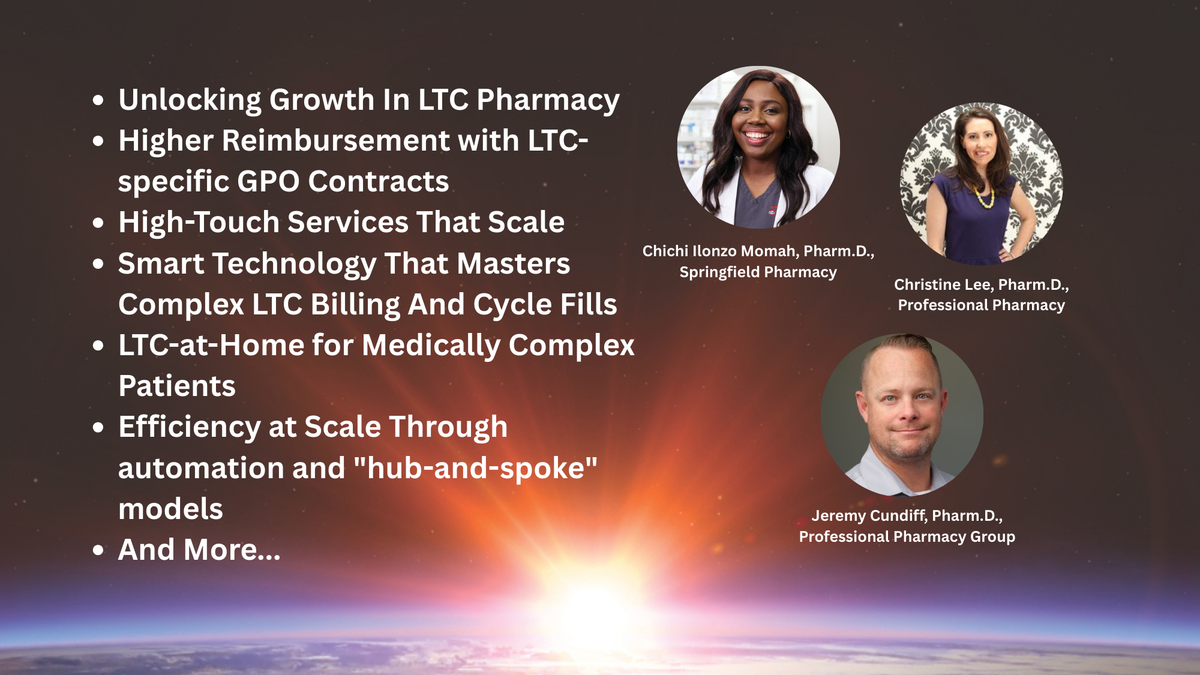
Christine Lee, Pharm.D., has owned Professional Pharmacy in Baltimore, Md., for over nine years. When Lee first purchased the pharmacy, the small number of LTC homes it served was a new book of business for her. At the time these LTC patients were not being treated within the pharmacy workflow any differently than typical retail patients, except for basic packaging. “The pharmacy was not using any LTC-specific technology,” says Lee. “We didn’t have any contracts through GPOs for purchasing and billing at LTC rates, either. We were just doing everything at retail rates.”

It took Lee a few years to get to a point where she felt it made sense to sign up with a GPO. “At that time, about seven years ago,” explains Lee, “these contracts weren’t the norm for combo shops like mine, and it wasn’t clear to me that the difference in profitability of the LTC contracts was worth the effort involved.”
However, as retail reimbursement rates continued to plummet, the more favorable LTC rates eventually made the transition a “no brainer,” as Lee puts it.
“We now have a robust long-term care business,” says Lee. “We’ve expanded not just to assisted living facilities; we do a fair amount of business in the group home space as well.”
Chichi Ilonzo Momah, Pharm.D., is the owner of Springfield Pharmacy in Springfield, Pa. Momah reports that she saw an opportunity to enter the LTC market around six years ago when she bought an area pharmacy with a good LTC business. “I knew it could be hard to get into the LTC space,” says Momah. “You need referrals to facilities, for example, but the pharmacy I bought gave me a few initial accounts.”

There was definitely a learning curve, notes Momah. “Longterm care pharmacy is like a whole different language,” says Momah. “It’s like you’re speaking Spanish, and instead of getting into a business that’s speaking a related language like French, you are suddenly having to speak something totally different, like Russian.”
Jeremy Cundiff, Pharm.D., is president and co-owner of Professional Pharmacy Group, which operates five pharmacies in Maryland. One of these is a large closed-door LTC pharmacy that serves about 3,000 beds across assisted living facilities, developmentally disabled patients, and hospice patients.

Additionally, Cundiff has built a leading-edge model that integrates LTC services across all the pharmacies in the group. “I don’t view LTC and retail dispensing as different silos in the business,” he explains, “but as interrelated.” Key here is the fact that all the pharmacies are within 25 to 30 minutes of each other, and this allows Cundiff to use what he describes as a hub-and-spoke care model that not only provides services to LTC facilities, but LTC-at-home patients as well.
Unlock The Story To Read About...
- Higher Reimbursement: Leverage LTC-specific GPO contracts to bypass shrinking retail margins.
- High-Touch Care: Scale with 24/7 support, specialized packaging, and coordinated medication reviews.
- Smart Technology: Use advanced pharmacy software to master complex LTC billing, cycle fills, and facility codes.
- LTC-at-Home Growth: Support medically complex patients staying at home with facility-level service models.
- Operational Efficiency: Deploy automation and "hub-and-spoke" workflows to increase volume without adding headcount.