Future-Proofing Pharmacy Tech Training: Cloud-Based Software and the 2026 PTCE Updates
How cloud-based CPhT training software eliminates IT barriers while providing the 24/7 remote flexibility and clinical scenarios needed to master the new 2026 PTCB domains. | Sponsored
As the pharmacy landscape shifts toward value-based care, the role of the pharmacy technician is undergoing a significant transformation. Starting in January 2026, the Pharmacy Technician Certification Board (PTCB) will implement rigorous new standards for the PTCE, placing a heightened emphasis on medication safety, federal compliance, and advanced inventory management.
In this episode of the Pharmacy Technology and Management Review podcast, host Will Lockwood sits down with DAA Enterprises VP of Information Technology Ismail Fenni and Karen Davis, CPhT, to explore how DAA’s innovative Visual SuperScript Cloud Edition pharmacy management software is revolutionizing the way pharmacy technician training programs can meet these new demands.
Davis is a seasoned pharmacy technician, instructor, and textbook author, and owner of SEPhT, a pharmacy technician educational company. She is also a pharmacy solutions consultant for KbPort, a software and hardware development company focused on improving educational outcomes.

Traditionally, pharmacy training programs were tethered to physical labs and complex local server architectures, creating significant burdens for IT departments and limiting student access. We’ll talk about how DAA’s cloud-native approach eliminates these barriers by providing a seamless, secure, and highly flexible learning environment and how this platform simplifies institutional deployment and provides the “future-proof” tools necessary to prepare the next generation of pharmacy technicians for a rapidly evolving profession.
In This Interview You Can Learn About How:
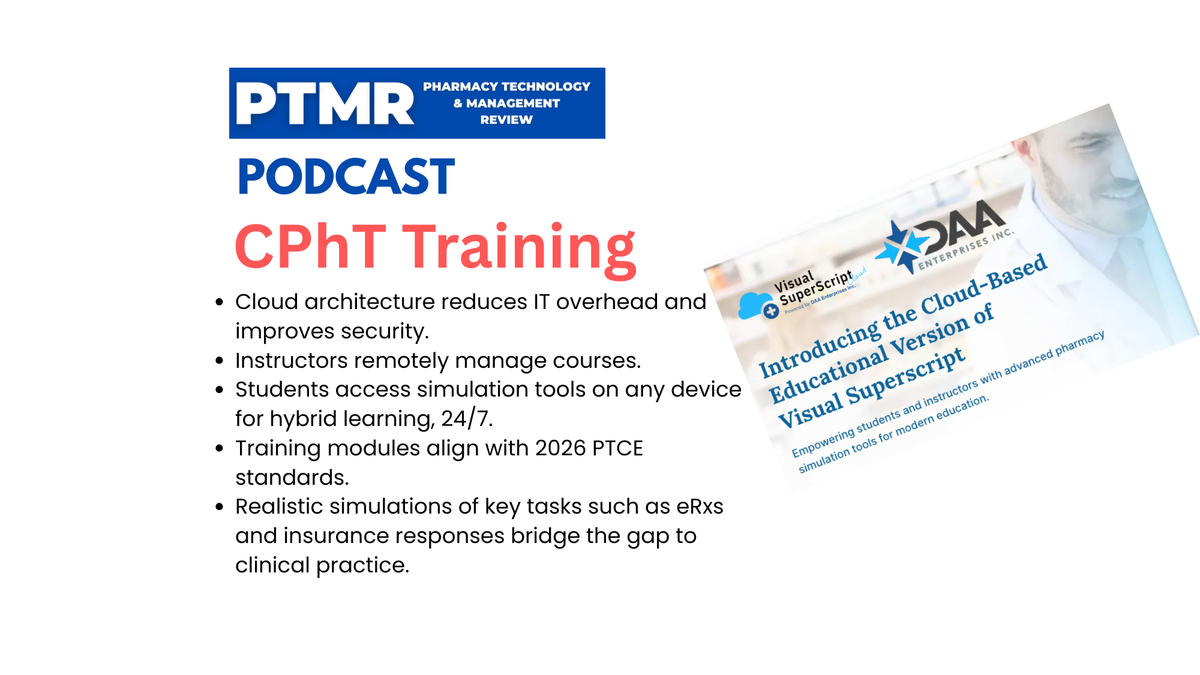
- Cloud architecture eliminates complex server installations to reduce IT overhead and improve security.
- Instructors can remotely design real-world clinical scenarios and pharmacy cases from any location.
- Students benefit from 24/7 remote access to simulation tools on any device for hybrid learning.
- Training modules align with 2026 PTCE standards.
- Realistic simulations of key tasks such as eRxs and insurance responses bridge the gap to clinical practice.
Learn More: Visual SuperScript Cloud
PTMReview: This is Will Lockwood from Pharmacy Technology and Management Review. And in today’s podcast I am speaking with Karen Davis and Ismail Fenni. And we’re going to be talking about DAA’s cloud-based educational training software designed for pharmacy technician training programs.
“They need to know how to handle those scenarios before they ever see a patient in front of them.”
And in particular we’re going to talk about how cloud-based architecture is a real bonus and a real plus when you’re talking about this kind of educational software. So I want to get into it with Ismail and Karen, and talk about the cloud-based nature of it and how it addresses IT concerns from the institutional perspective. So for the educational institution, how is cloud-based better than a traditional model?
Learn More about Visual SuperScript
Modernizing Pharmacy Tech Education with Cloud-Based Software
Ismail Fenni: First, thank you for doing this and for shedding some light on the need for this kind of software. We have been providing pharmacy management applications for quite some time, for decades, to be honest with you. DAA has been at the forefront in providing not only support, but also such an application as pharmacy management. For the last maybe I want to say 33, 35 years.
And certainly we want to also address the need for those pharmacies to be able to train their technicians both in terms of using the application, but also to provide a way to increase efficiency within the pharmacy. We know that a pharmacist or a pharmacy, when they hire a pharmacy tech, certainly it would be a huge advantage for them to know that they already are familiar with using software applications such as ours.
Traditionally, and I think this is true with other vendors as well, the approach was to either provide a server machine where the application is installed and used within a pharmacy. Or perhaps one step up would be to have what we call a client server set up. So you’d be a server with workstations attached that would then provide access to the application through those workstations to the different technicians and pharmacists.
“The instructors have the ability to get into the system from anywhere.”
Today we offer this approach where pharmacists and technicians are able to access the application from anywhere. And this is very accommodating, especially within a learning institution that targets the teaching and training of technicians. To be honest with you, I don’t know if any other vendor has such an offering of a cloud-based application. Not only does it help in mitigating their needs for using the application, meaning it will reduce any overhead from their IT to support or to provision any equipment aside from providing internet access to their students.
Simplifying Institutional IT and Data Security for Pharmacy Programs
PTMReview: Ismail, before we move on to talk a bit more about the benefits for the people who are actually using the software, I want to step back just for a second and talk a little bit more about the institutional level and it, how this benefits IT departments and the educational or healthcare organizations that need to deploy training software like this. The normal model, like you said, is they have to deploy a lot of infrastructure to support a software install like this. But in this case, there’s no intrusive software that has to be hosted by the institution. There’s no infrastructure that has to be set up. And then this kind of cloud-based architecture is also going to have a big impact, a positive impact, on security as well, correct?
“It certainly adds this level of freedom both for the instructors and students and as well the institutions.”
Fenni: Certainly, and this is something that is truly crucial and important to most institutions and hospitals and IT departments, being cloud-based, it certainly alleviates the concerns about installing any intrusive software onto their own equipment onto the school or hospital IT infrastructure. While at the same time also not interfering with it with their existing setup. So being cloud-based, it also reduces any concern that may be present, otherwise if it were a client server architecture or local machine, about data breaches or security risks.
Certainly this aspect of security, this aspect of alleviating the need for additional resources to be deployed by the IT department. The cloud-based approach enables the IT departments of each institution to easily deploy it and easily accommodate as many students or as many instructors as they see fit. From that perspective, it certainly is a huge plus for many, if not most, IT departments.
DAA VisualSuperScript | Learn More
Enabling 24/7 Access and Hybrid Learning for Pharmacy Students
PTMReview: Okay. Wonderful. So then moving on to some of the benefits, which I think you were getting ready to touch on, Ismail, some of the benefits within the classroom setting within an educational setting itself. What are some of the advantages of a cloud-based system for instructors and for students?
“They can set those kinds of scenarios without ever being at the school.”
Fenni: I just want to contrast that to the traditional approach with a client server or a standalone system, where the instructor or the student has to physically be present within the confines of the institution. Being cloud-based allows for that to still be available should the institution require it, but also it provides that additional degree of freedom where basically it enables students and instructors to access the software remotely, 24/7 in fact, via the internet. It allows both in-person students to work on assignments and practice away from campus using any device that may be available, whether it be a desktop or laptop or even a large screen tablet, as long as they have internet access.
Simulating Real-World Clinical Scenarios in the Pharmacy Classroom
PTMReview: Karen, you have a lot of experience working directly with CPhT training programs and educators. Do you have some practical examples, some real life experience where you’ve been talking with people and you’ve really come to understand some of the pain points that a cloud-based architecture addresses?
Davis: Yeah and based on what Ismail was saying, one of the things that I think if you look at it from the cloud based system, the instructors have the ability to get into the system from anywhere. A lot of instructors have certain times of the year that they get ready for their labs. They go ahead and prepare. That gives them this ability to do this, and they can do this from home. They can do this over the Christmas break, whatever it is. They can go into the system, set up real case scenarios. Say you want to teach medication synchronization, medication adherence.
“Being cloud-based, it certainly alleviates the concerns about installing any intrusive software.”
They can use an existing patient in the system, or they can create a patient. Completely change their profile, give them a list of medications, refills that haven’t been filled. They can simulate text messages so that the patient has to come in and have a conference. They can go ahead and set those kinds of scenarios without ever being at the school. And they can think through those processes, go ahead and get what they’re going to do for grading perspectives.
In today’s value-based care system, they’re going to get training if they go to an internship, but instructors aren’t going to be able to prepare them for those scenarios. There’s not patient medications involved at the school system, but they get that feedback. They go ahead and get real life feedback. They can get it in the classroom with the student, or they can actually look at those records at home and give them feedback as an assignment, as a hybrid course.
Aligning Pharmacy Technician Training with 2026 PTCE Standards
PTMReview: There’s a tremendous amount of functionality and flexibility that comes from the cloud... and then one other thing I think I’d like to touch on if we can Karen, is that my understanding is that programs are going to have the need to address new content for the pharmacy technician certification exam, the PTCE, starting in January of 2026. Can you explain a little bit more about that? What’s new and what the programs needs are?
Davis: Sure. The new standards will start January 2026. The domains remain the same. They are medications, federal requirements, patient safety and quality assurance, and order entry. The distribution of the percentages has changed a little bit with more emphasis on medication safety and the quality assurance piece.
This software is ideal for that because again. It can give those real life scenarios and you can follow those domains. And obviously you can do order processing on a cloud-based server cloud-based program so that you can put in those scenarios that we were talking about. It does allow the learner to practice in that simulated environment and actually demonstrate those things that are required in that PTCE, like event reporting, error prevention techniques, medication compliance.
“I don’t know if any other vendor has such an offering of a cloud-based application.”
The other important thing that’s changed a little bit with percentages is there’s more focus on inventory management, and that’s a big thing. There are certifications out there for that. PTCB has one, but again, with the value-based care, we want to make sure that we get them the right medication, the therapeutic equivalent medications, which is also one of the domains. That percentage is a little bigger on that with this new one, and basically the system allows the learners to demonstrate the reporting, which is required, the tracking, the supply chain activities, and control substance handling.
Learn More about Cloud CPhT Training
Advanced Simulation and Future-Proofing for Technician Training
PTMReview: Ismail, if I can throw the ball to you here for a second, from what I’m hearing Karen say about loving that flexibility, you all didn’t have to do anything in your software to address these new content needs for programs, the flexibility inherent in the software allows for this already. Is that right?
Fenni: Oh, absolutely. And we truly are very excited about our product. Certainly, in addition to being the only product out there that offers this kind of flexibility being cloud-based... the application itself provides an aspect for training that was not available in the past. For example simulation. We have a way to simulate, for example, insurance responses. Simulate electronic prescriptions, faxes. The instructor is able to, in real time, handhold a student, for example go onto their screen and be able to interact with them in real time.
PTMReview: So there’s a real element of future proofing in all this flexibility.
Fenni: Absolutely. Yes. And we’ve gone through extensive testing to make sure that, not only will it withstand the demands of the institutions and structures and students, but also for us to be able to provide that kind of level of functionality that would be also open for future enhancements as well.
PTMReview: Thank you. I think this has been very informative for me, certainly. And I hope it will be for our listeners out there. Ismail, Karen, thanks for your time today.
Cloud-Based Training: A Game Changer for Pharmacy Techs
PTMReview: Okay. Thank you so much for that. So we'll jump into talking about this pharmacy software that DAA offers and how it's used in a pharmacy technician training program. And in particular how it can represent the workflow of a pharmacy in a realistic way that allows the students to develop practical skills.
Sponsored