Activating Your Pharmacy Management System
Most pharmacies use only a fraction of their system's power. Find out how to unlock the features that drive real efficiency and long-term success.
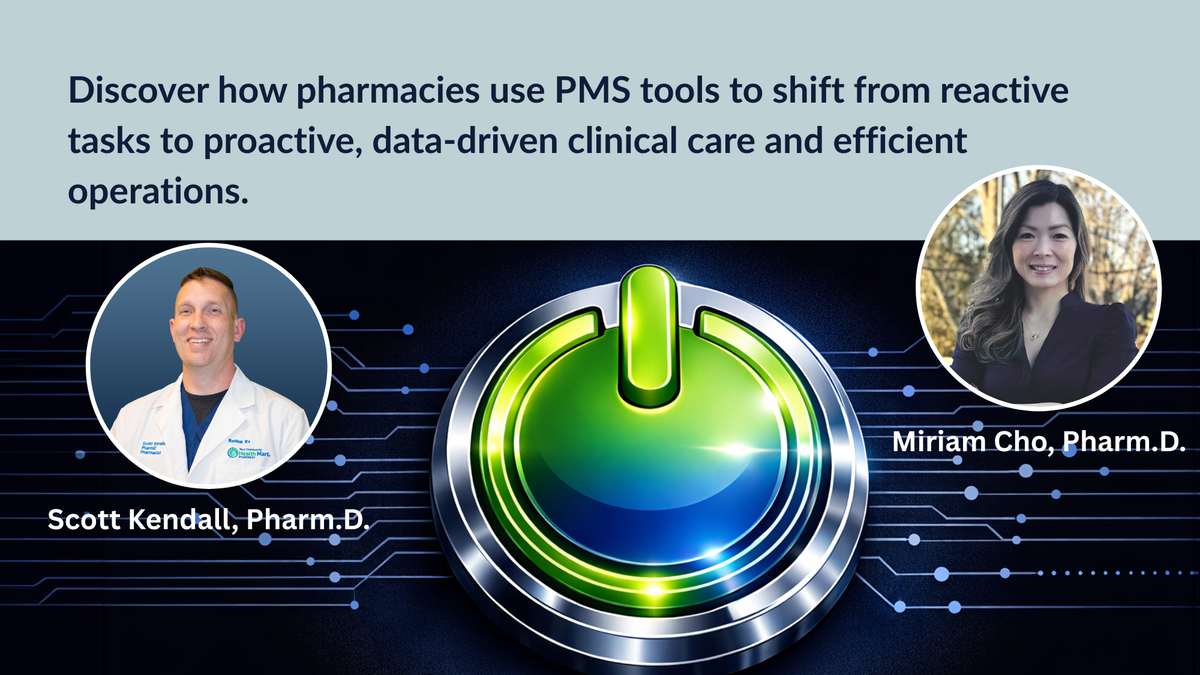
Most pharmacies use only a fraction of their system’s power. Find out how to unlock the features that drive real efficiency and long-term success.
Modern pharmacy management systems are built to offer a wide range of tools, but are pharmacies maximizing the use of this asset in practice? While most pharmacies rely on their software for basic dispensing, we will find out how three pharmacies are operationalizing technology as the key to sustainable growth. Find out how you can use features within pharmacy software to move from a reactive, task-based culture to a proactive, data-driven environment; leverage automation to reduce overhead and optimize inventory; and, most importantly, free up pharmacists to make high-value clinical care the foundation of modern pharmacy practice.
Shifting From Reactive to Proactive Operations
Scott Kendall, Pharm.D., a pharmacist in charge and Rx operations manager for ReNue Rx, a group of seven independent clinic-based pharmacies in the Dallas-Fort Worth area, identifies the medication synchronization (med sync) application in Liberty Software as a foundational tool for moving beyond traditional dispensing toward high-level clinical care. “Med sync has been around forever,” says Kendall. “I think most pharmacists understand what it is, but are not really using their pharmacy management system effectively for it. The hurdle I hear from pharmacists is that med sync takes too much time. And I do understand some of that. However, med sync is really the ounce of prevention that is worth a pound of treatment.”
Unlock the Full Blueprint for Pharmacy Efficiency
Most pharmacies only scratch the surface of their system’s capabilities. Subscribe to Pharmacy Technology & Management Review to read the rest of this exclusive feature and discover exactly how top pharmacies are maximizing their ROI.
Subscribe to unlock:
- The Med Sync Step-by-Step: How to turn a basic application into a proactive engine that drives clinic contracts and automated billing.
- The 60-Minute Benchmark: The exact data points and hiring metrics used to scale operations 45 to 60 days ahead of onboarding new business.
- Inventory Secrets: How to leverage forecast-based purchasing to hit 18 to 23 turns per year and free up critical cash flow.
- AI & Automation Workflows: Inside the custom tech stacks reducing cost-to-fill and minimizing manual data entry errors.
Kendall reports that ReNue Rx’s Liberty Software system makes it easy to toggle med sync functionality on. “From there you are picking a date for a continued refill of that patient’s medications,” he explains. “We try to get everybody that’s on two or more chronic medications on med sync.”

Med sync also drives the call list prompt within Liberty, according to Kendall, and allows the pharmacy team to prework profiles ahead of patient calls and identify needed immunizations, dosage changes, or clinical reviews before the patient arrives. This shifts the pharmacy to a workflow based on planned, efficient operations.
“By starting with med sync, controlling the date that we fill, and then using the call list prompt,” says Kendall, “we can be so much better prepared. When Ms. Smith comes to the pharmacy counter, for example, we know that it’s been three months since we last checked her A1C, and that it’s now time for this action based on the contracts that we have with Outcomes or EQUIPP. It’s the med sync function that initiates the planning for this intervention. This is a tool that you need to be using in order to direct your efforts and have the conversations that lead to improved outcomes for the patient.”
Data-Driven Staffing
Pharmacies can use their software to become more proactive in the key area of staffing, as well.
Scott Kendall notes that once med sync is activated, more efficient staffing is one of a number of downstream operational benefits for the pharmacy. “Since we know when a patient is coming in for all their prescriptions, we are able to schedule pharmacists more efficiently,” he says. “We also keep less inventory on the shelf, particularly for expensive brand-name medications, because we know exactly what will be needed two to three days in advance.”
Another tip from Kendall for managing staff effectively: He is using an appointment scheduler to formalize clinical services by allowing pharmacists to book short consultations or phone calls and prepare for billable clinical services ahead of time. “This feature allows pharmacists to use the same time it takes for an immunization to address other identified gaps in care,” say Kendall, “such as colonoscopy reminders or reviewing electronic health record [EHR] notes from the clinic. And it’s all built on knowing in advance when you will see a patient.”
Miriam Cho, Pharm.D., is president and chief pharmacy officer of MAC Rx/MedScript, a long-term care (LTC) pharmacy with three locations in Illinois, Indiana, and Missouri. Cho has built her career specializing in the high-level use of pharmacy technology to drive organizational structure and clinical safety, moving her team beyond basic dispensing toward data-driven operational scaling and enhanced patient therapy outcomes. While many pharmacists use reporting for retrospective review, Cho suggests using productivity and benchmarking features to proactively manage human resources.

“We have a number of benchmarks we monitor in SoftWriters FrameworkLTC and FrameworkBI,” says Cho. This includes the number of prescriptions per full-time employee (FTE). “We’ll look at the staffing it takes to dispense 1,000 prescriptions, and then we set benchmarks based off of that,” continues Cho. For instance, Cho wants a prescription that comes into the pharmacy to move through every single step of the operation in 60 minutes or less. “We’re able to set that standard because we can pull that data from our software,” she says.
This is data that helps Cho determine whether operational benchmarks are both plausible and tangible. “We can use data to objectively identify where we can do better and to learn how we can encourage our teams to be productive and accountable,” she says.
For example, Cho reports using individual productivity and quality event data to coach staff. “We may have a clinically strong pharmacist making errors that we can see are due to high volume,” she says. “The data can help us guide them to slow down to a safe benchmark.”
If a staff member is not performing up to standard, Cho can also use benchmarked data to improve clinical outcomes and manage staff performance through processes such as performance improvement plans. “We can have these conversations with underperforming staff without making it personal,” she says.
The Backbone of Growth: Automation and Accuracy
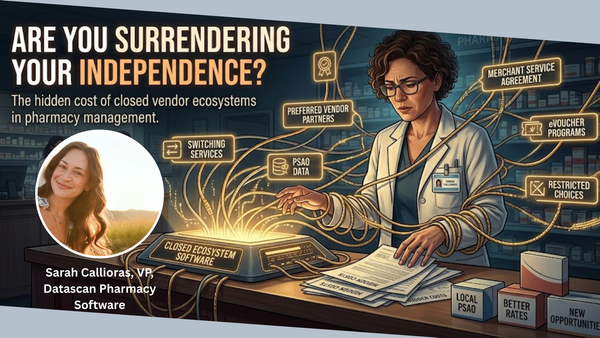
Mark Franceschelli, Pharm.D., is the owner of Accudose Pharmacy in Youngstown, Ohio, a community known for its close-knit neighborhoods and strong local businesses. Accudose Pharmacy set out with a clear mission: to simplify medication therapy for patients while improving adherence and outcomes. As the healthcare landscape grew more complex, Accudose recognized that achieving this mission at scale would require the right technology partner. That partner became Datascan.
From the beginning, the collaboration between Datascan and Accudose was built on a shared vision — using intelligent automation and data-driven workflows to transform pharmacy operations without losing the personal touch patients value. Together, they focused on expanding Accudose’s reach into the patient market by consolidating medication therapy into streamlined, easy-to-manage solutions that reduced confusion and improved compliance.
Datascan’s platform quickly became the backbone of Accudose’s growth. Custom-written multidose verification workflows ensured that each patient’s medications were accurately packaged, verified, and delivered with confidence. Robotic interfaces integrated seamlessly into daily operations, reducing manual steps and increasing throughput without sacrificing safety. These technologies allowed Accudose to scale responsibly, meeting rising demand while maintaining the high standards patients and providers expect.
Empowering the Team Through Intelligent Innovation
Through collaborative team efforts, Accudose embraced innovation not just as a means of growth, but also as a way to empower the pharmacy team. By pioneering AI (artificial intelligence) integration and incorporating intelligent agents to assist with data entry, Accudose reduced administrative burden and minimized errors. This allowed pharmacists and technicians to focus on highervalue tasks — patient counseling, therapy optimization, and relationship building — while automation handled repetitive processes in the background.
“As the landscape of pharmacy continues to evolve, we are continually trying to be proactive and evolve with it,” says Mark Franceschelli. “We realized the need to further automate our business with robotics but also with some incredible AI software custom-designed for our business. These changes have dramatically changed our efficiency, decreased our cost to fill, and provided a platform for growth. It helps to have a great partner in Datascan that allows for the integration and implementation of our ideas. It makes a tremendous difference when your pharmacy management software company is willing to be forward thinking and grow with you.”
Forecasting for Growth
Data also allows for strategic scaling. Instead of scrambling and hiring blindly when onboarding new business, Cho recommends using your historical data to forecast staffing needs. A quantitative approach allows for a data-driven strategy to maintain operational standards during periods of rapid growth. Cho reports using granular, employee-level data for precise workforce planning and departmental workflow management. By leveraging historical metrics, such as the average number of prescriptions per patient in skilled nursing facilities, Cho can forecast the total volume increase when onboarding new accounts. “We have benchmarks across functional areas, like order entry, fulfillment, and billing,” she says, “that we can then translate into specific strategic hiring goals for our team 45 to 60 days in advance based on the forecasted increase in prescription volume that new business will bring.”
Another area to apply data is bottleneck identification. MAC Rx/MedScript uses FrameworkLTC workflow tracking to see exactly when and where a department is failing. “We’re analyzing the actual workflow to make our processes more efficient down to the physical steps that a technician is walking to grab a drug or print a label,” says Cho. “You might take a look at your departments and find out that, at 5:00 PM every day, your billing team is bottlenecking the workflow. FrameworkBI allows us to track workflow at this level. We can even run productivity reports for each employee broken down by wage category, such as pharmacist, billing technician, orderentry technician, or fulfillment technician.”
When you use this kind of analysis to look for departments that aren’t using resources effectively, you can then consider reallocating staffing so that other departments aren’t underresourced.
“You have to have the power and the tools in your technology to harvest that data,” continues Cho. “You need to be able to digest it and get actionable intelligence from it. It is literally going to decide whether your pharmacy is staying on task and whether patients are receiving medication within the necessary time frame.”
Inventory and Financial Integrity
Cho highlights inventory features in FrameworkLTC as a critical way to protect cash and maintain and even improve margins. First, she suggests, take a look at forecast-based purchasing. “We use physical drug zones and forecasting reports in a perpetual inventory to guide purchasing over 24 to 72 hours,” she explains. “This frees the purchasing team from walking the shelves so they can focus on evaluating costs and buying efficiently, which then leads to the financial margins that give us the resources for much better health outcomes.”
Cho notes that effective use of perpetual inventory has led to 18 to 23 turns per year at her pharmacies, and minimizes out-of-stock drugs while keeping shorter days’ supplies on hand. “Effective inventory management really allows us to then stage ourselves for growth,” says Cho. “We have the cash flow to be able to move decisively when we have a facility that needs to come on board in a month. We have the cash to hire and to purchase carts or e-kits, for example. Strong inventory management sets us up for financial success.”
Scott Kendall already mentioned the benefits to inventory management from med sync, and he also sees further opportunity for pharmacists to gain more financial value by improving the use of electronic data interchange (EDI) and usage-tracking integrations to provide actionable cost and usage analytics. “You want to be able to analyze drug usage and turns to determine the exact number of tablets needed on hand and set up orders automatically,” he says. Kendall recommends using your software to identify how to order by NDC and supplier to ensure generic compliance rates (GCR). “Pharmacy staff should not be going in and manually searching and pulling all this information,” he says.
Automating Flags, Documentation, and Billing
The value of the planned patient interactions made possible by med sync is multiplied significantly by another set of features Kendall recommends using: automated clinical flags, for example for comprehensive medication reviews (CMRs). The alerts occur in several different ways, according to Kendall.
One is automated from outside vendors. “Liberty does a great job working with our other vendors,” says Kendall. “For example, both Outcomes and EQUIPP are integrated into our pharmacy system so that we see their flags for patients that need a CMR, a TIP [targeted intervention program], or another employer group program that we’re contracted for.”
Then you will want to be able to automate documentation of the actions these flags prompt us for. For this, Kendall reports that ReNue Rx uses an integration with CPESN, which allows the software to pre-write SOAP notes by pulling in dispensing data. “The pharmacist only has to enter basic values like A1C or blood glucose levels into this prefilled note,” he says. “We are automating almost all the pre-work that gets done in a medical office for a provider. So something that would take you quite some time to complete on your own is relatively quick because of the integration with those programs.”
ReNueRx has also been able to automate medical billing through an integration with DocStation that captures medical claims based on prescription data and pre-populates billing codes and diagnoses without manual intervention from staff. “It captures claims based on insurances that pay for direct services from pharmacists for consultation on medication,” he says. “The pharmacist just needs to go into the third-party system and finalize the claims.”
Safety and Quality Through System Mastery
Miriam Cho reports that MAC Rx/MedScript is using its data to run quality assurance (QA) programs consistently across all three locations, both retrospectively and prospectively, and this is something pharmacies should be looking to do with their systems. A simple example of retrospective QA is handling medication recalls. “You need to be able to run reports by lot number to quickly identify affected patients,” says Cho. “Then you use this data to coordinate between customer service and operations to retrieve and replace the impacted prescriptions immediately.”
Prospective QA is a more sophisticated implementation, and at MAC Rx/ MedScript one example is leveraging FrameworkLTC to maintain quality standards that allow for post-verification (PV2) exemptions where permitted. “In this case, we perform prospective QA twice a day,” explains Cho. “We are comparing our current output to the PV2 exemption program’s metrics, and we can verify immediately if we’ve hit our targets. Having the tools to continuously monitor our PV2 exemption performance allows us to free pharmacists and ensure that the human element is focused on clinical intervention and collaboration with healthcare providers. We aren’t removing the human touch. We’re enhancing its impact.”
There’s also a broader role for multilayered alert and notification systems that extend beyond the clinical flags discussed earlier, according to Scott Kendall. ReNue Rx pharmacies are having success using alerts for recurring tasks. “This goes beyond simple notes,” Kendall says. “Once a patient’s been identified as needing pharmacist follow-up or additional training for their disease state, that goes into Liberty as an automated note with a recurring task typically set to the med sync date.” The alert can also be for something more basic, such as wishing a patient a happy birthday. A task list auto-populates on the pharmacy system homepage and informs staff of how many tasks they need to complete during the day. There are also internal notes that apply to just a specific prescription and give a technician or cashier instructions for interacting with the patient.
Security restrictions ensure that the right staff member handles alerts and notes. “This means we can require a pharmacist to unlock or clear a clinical alert when it’s not appropriate for a technician or cashier to be involved,” explains Kendall.
Vendor Collaboration and Pharmacy Champions
In Cho’s view, the defining element of success at MAC Rx/MedScript is the presence of a pharmacy champion for each technology system at each location.
“These are our on-site experts,” she says. “They don’t just troubleshoot, they drive innovation by working with SoftWriters and our other vendors to customize procedures that mitigate financial risk and improve efficiency.” For example, over the years these champions have worked to customize IV drug procedures and make perpetual inventory a foundational piece of pharmacy performance.
“We have been able to empower individuals with responsibility for getting the most out of our technology,” says Cho, “and they can grow into experts and managers who contribute to so much of our success and our growth.”
Enhancing Engagement Beyond the Pharmacy Walls
At Accudose, Datascan’s tools have strengthened patient engagement beyond the pharmacy walls. Text messaging and mobile applications keep patients informed and connected, delivering reminders, refill notifications, and real-time updates that encourage adherence. Shipping integrations further extend Accudose’s reach, enabling reliable and efficient delivery to patients who need consistent access to their medications. Each integration has removed friction from the process, creating a smoother experience for both patients and staff. As Accudose continues to expand, its partnership with Datascan supports the need for a software system that can evolve with the pharmacy.
Transformative Results and a Resilient Future
The results of the partnership with Datascan have been transformative for Accudose, which has experienced substantial growth, and expanded its patient base while improving operational efficiency and profitability. Datascan’s technology enabled the team to do more with less, building a scalable model that balanced automation with personalized care. What has emerged is not just a more efficient pharmacy, but a stronger, more resilient business positioned for the future of healthcare.
Today, the partnership between Datascan and Accudose Pharmacy stands as an example of what’s possible when technology and pharmacy expertise align. Together, they continue to redefine medication management, improving compliance, enhancing patient outcomes, and proving that innovation can strengthen both community care and business success. Datascan delivered what Accudose needed: a partner willing to listen, innovate, and support a technology-first approach to independent pharmacy. Ultimately, Miriam Cho sees success building from how pharmacies can refine processes and develop systems to meet the specific operational goals that allow them to successfully scale their services. This transition from basic usage to high-level system management ensures that the software remains an asset during both rapid growth and organizational transitions. “Our success is built on our people and our technology,” says Cho. “Our focus on mastering systems, starting with our suite of SoftWriters software, has allowed us to scale effectively.”
For Scott Kendall, the ultimate goal is for pharmacists to practice at the top of their license, and this begins with a commitment to fully operationalizing technology. Transforming the pharmacy from a reactive to a proactive environment and leveraging sophisticated vendor integrations streamlines complex clinical tasks into efficient, manageable workflows. Kendall says that at ReNue Rx, the approach is to ensure that the pharmacy management system is leveraged to its full potential so that it empowers the team to focus on high-value patient interactions while maintaining rigorous operational and financial control. “Pharmacy has to move away from just reacting as prescriptions come in the door, to where we are taking proactive steps to plan and manage our work with efficient, automated processes,” he says.
While these three pharmacies are examples of pharmacy technology power users, they do also serve as reminders that the tools are there in your software. It’s a matter of digging in to learn, plan, and flip the switch to activate the full potential of your pharmacy operations. PTMR