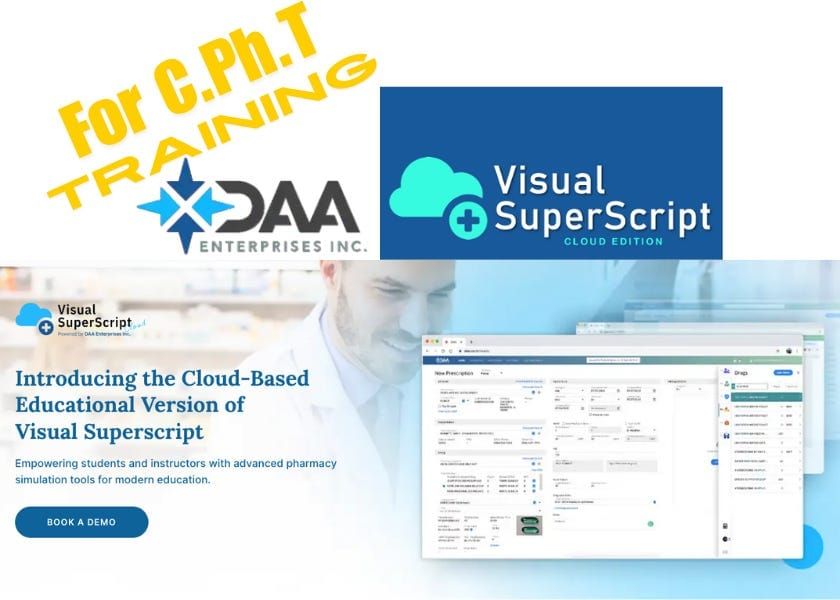
Pharmacy Technician Training in The Cloud: Flexible Solutions from DAA Enterprises
How DAA Enterprises is revolutionizing the training landscape for certified pharmacy technicians (CPhT) programs through cloud-based pharmacy management software. | Sponsored
In this interview, Pharmacy Technology & Management Review’s Will Lockwood talks with Anwar Kazmi, President of DAA Enterprises
What You Can Read About In This Interview
- Revolutionizing Pharmacy Technician Training
- Cloud-Based Training: A Game Changer for Pharmacy Techs
- Essential Skills for Pharmacy Technician Certification
- Mastering Insurance Claim Adjudication in Pharmacy Technician Training
- Advanced Modules for Comprehensive Pharmacy Technician Training
We’ll take a look at how DAA Enterprises is revolutionizing the training landscape for certified pharmacy technicians (CPhT) programs through DAA’s Visual SuperScript Cloud Edition pharmacy management software, designed to provide aspiring pharmacy technicians with an unparalleled, realistic training environment and practical experience.
Find out how the system bridges the gap between theoretical knowledge and practical application, offering students individual "pharmacies" to manage with robust simulation of complex workflows that provide crucial experience with tasks like insurance claim adjudication and medication synchronization — all vital for success in today's demanding pharmacy settings and for meeting rigorous certification standards.
Revolutionizing Pharmacy Technician Training
PTMReview: We're going to be talking with Anwar Kazmi about DAA Enterprise's efforts to provide training solutions for certified pharmacy technician programs. Anwar, do you want to start off by introducing yourself?
Anwar Kazmi: Sure. Thank you, Will. I am the president of DAA Enterprises. We have been in the business of pharmacy management software systems for a little over 40 years now. We were asked by the president-elect of what was then called the National Association of Retail Drug to develop a computerized system for their members. And it was referred to or described as a “smart typewriter” in those days. Of course, pharmacy management software has come a long way since then. And DAA has been part of that evolution at every step of the way. In the year, around 2005, 2006, we partnered with one of the nation's leading publishers of educational materials to adapt our pharmacy software to the educational environment for pharmacy technicians.

And our most recent offering in this area, both in the commercial as well as in the educational environment, is a cloud-based system, which is very sophisticated and has many benefits for pharmacists, for instructors and for students. And we can go into the details of that when you think it's appropriate, Will.
Thanks for reading Pharmacy Technology & Management Review! This post is public so feel free to share it.
PTMReview: Okay. Wonderful. Thank you for that background.
Cloud-Based Training: A Game Changer for Pharmacy Techs
PTMReview: Okay. Thank you so much for that. So we'll jump into talking about this pharmacy software that DAA offers and how it's used in a pharmacy technician training program. And in particular how it can represent the workflow of a pharmacy in a realistic way that allows the students to develop practical skills.

So Anwar, if we can, let's start with you and let's talk a little bit about that. The way that the software, your cloud-based software, offers the ability to create a real world pharmacy workflow in the training environment with all the various queues and dashboards. And tell me how you've designed this to create the optimal learning experience.
Kazmi: Yes. It would be a pleasure to do that. Let me first mention that the system is designed in such a way that for each student it's like they're operating their own pharmacy. The whole database is replicated as soon as a student's record is created, a student is added to the institution.
All the different files and patients, doctors, drugs, and so on and so forth are replicated for that student and it's as if they are operating their own full fledged pharmacy. I think that's a unique feature of our system and it's very different from other systems. Even for the educational environment where it may be like a demo version of a company's software and it's installed on the school network, for example, with maybe one or two terminals.
"For each student, it's like they're operating their own pharmacy. The whole database is replicated... it's as if they are operating their own full-fledged pharmacy."
Only one or two students can work with it at a time. And then a big disadvantage is that if there are some exercises that are either prescribed by the instructor, or that are in the accompanying workbook, as soon as one student performs that exercise, it preempts others from being able to do that. The others just basically stand there and watch. So I think this one is completely different in its approach. Each student has their own independent pharmacy. They can add patients, doctors, drugs, fill prescriptions and not have any impact on their fellow students.
So I think that's something which is unique. The other advantage, from having this cloud based architecture, is the fact that the students can use it or can access it from anywhere at any time. All they need is some sort of a device capable of running a browser.
It could be a laptop. It could be a PC. It could even be a tablet. Just a device that is capable of running a browser, that's all that they need. And they can access the system from anywhere, teachers as well as students. And so that's also a major advantage of this.
Another one, which I should mention here, is something that saves the IT people of that institution from a big headache. They don't have to give access to anybody to their computer network, because the system is not installed on their network.
The students do not access anything on the school’s computer network. And so that's a big relief to the administrators, as well as the IT personnel. So these are some of the advantages. Now, as I said, once the student is operating like their own pharmacy. They can go through all the tasks that have to be performed in a real pharmacy.
We also have what we call a mock service for adjudicating claims. We obviously don't actually send these claims to a private third party, but these claims, whatever claim they submit, are intercepted by our software. Based on the adequacy of the data submitted, the students get either a “paid” response, or a “rejected” response. Then they have the opportunity to correct things and resubmit the claim. This gives the student a good feel for what happens in the real world.
And we can talk about that in greater detail as well.
PTMReview: Okay, wonderful. And so the real key difference I'm hearing is that clearly in a real world pharmacy environment you do not want more than one person doing the same thing at the same time or working on the same record, changing records in a serial manner or whatever.
PTMReview: But in an educational environment, it's really important, like you said, for each student to essentially be able to run and manage his or her own pharmacy. And you've been able to set the system, your system, so that it is offering that capability. And, but at the same time, this is the same pharmacy management software that is available for a live pharmacy environment.
Kazmi: Absolutely. Yes, exactly. And this is as close as one can get to an experience of working in a real life pharmacy.
PTMReview: Got it. But it recognizes those student specific needs and some other needs of an educational environment.
Essential Skills for Pharmacy Technician Certification
There are a number of Pharmacy Technician Certification Board, PTCB, and ASHP standards and what students need to learn in order to be able to achieve the certification that's the end goal of these programs.
How Does Visual SuperScript Build Essential Skills?
- Self-Paced and Personalized Learning: The optimal learning experience for PTCB and ASHP accreditation requires real-life feedback and the flexibility for students to progress at their own pace and level of understanding.
- Customized Task Assignment: System permissions can be adjusted to tailor assignments to individual student proficiency—such as assigning advanced tasks to experienced students without disrupting the progress of beginners.
- Instructor Simulation Capabilities: Instructors can create custom scenarios and simulate prescriptions directly within the system to deliver the authentic, real-world working environment required by PTCB and ASHP.
- Safe, Risk-Free Practice: Students can learn community pharmacy tasks in a controlled, risk-free environment without potential harm to real patients before entering the workforce.
- Private Scenario-Based Feedback: Instructors assign specific scenarios, providing individualized feedback directly within the system that is visible only to that student.
- Alignment with Accreditation Standards: ASHP and PTCB standards require about 60% coverage across order entry, processing, and error prevention strategies, which live simulation directly fulfills.
- Hands-On Application vs. Theory: Bridges the gap between textbook discussions and practical execution by having students resolve real-world prompts (such as claims rejects, DURs, and controlled substance requests) within a real pharmacy management system tailored to their required skill demonstration.
Mastering Pharmacy Claims Adjudication in Training
Alright. Wonderful. Anwar, another area that I wanted to talk about, and you jumped into it a little bit and said we could get back to it, was this whole simulation of insurance claims. That's obviously a very complex area in pharmacy with a lot of variation depending on the plans and depending on the patients.
Dive a little bit more into that for us. Talk about how you are helping students learn how to manage responses, rejection messages, and DUR codes and learn about these tasks and gain real practical experience with them in a controlled environment.
Can you tell us a little bit about that, Anwar?
Kazmi: Okay. I appreciate that. Yes, I, as I said earlier, we have it's, the system is actually a full, fully fledged pharmacy management system with certain restrictions.
For example, we don't actually submit a claim to a third party. We have what we call a mock service that simulates that. But other than that the parameters, if I can use that term, for submitting claims are defined by what we refer to as an insurance table.
This is something standard in pharmacy management software. The parameters define what are the copays for brand name and generic drugs; which drugs are covered and which ones are not; and so on and so forth. Students work with exactly those same insurance plan tables that would be used in a regular pharmacy.
Now, as you said Will, that adjudication of claims can be something very complex. So we deal with all kinds of cases. Some of them could be relatively straightforward. For example, you submit a claim and you get a message: refill too soon. It could be because you filled that prescription only a week ago and it was for 30 days.
The system will put that prescription in a refill queue, and when the time comes for refilling, the system will bring it up and remind you about submitting that claim.
Similarly you can get a message: NDC not covered. The student could then select a different NDC, re-submit the claim and get it paid.
Now, there could also be more complex situations, especially those dealing with DUR, drug utilization review. You could get a pregnancy alert, for example, when filling a prescription for a woman who happens to be pregnant.
And you could have a drug over utilization alert, or an under utilization alert, a drug disease contraindications alert, or a drug-drug interaction alert.
So all of these kinds of alerts may come up during claim submission. In such situations, our system will give the trainee, the student pharmacy technician, the opportunity to address this situation. They may simply add that prescription to the queue of prescriptions that need to be reviewed by the pharmacist. Or, having taken appropriate actions under the supervision of the pharmacist, such as consulting the prescriber, resubmitting the claim with appropriate DUR Codes indicating the actions taken and the outcome of those actions.
So these are the kind of things that should give the pharmacy technician a feel for what they're going to encounter in real life situations.
The Impact of Real Practical Experience Working Through Tasks Within the Visual SuperScript Pharmacy Management System.
- Overcoming Externship and HIPAA Restrictions: Because HIPAA prevents students from accessing real patient data and performing live computer tasks (like adjudication or resolving rejects) during externships, simulation fills the practical training gap.
- Integrated Didactic and Laboratory Training: Connects classroom theory directly to lab exercises, ensuring students fulfill the laboratory-to-didactic ratios required by ASHP.
- Simulation of Advanced Scenarios: Instructors can set up specific, realistic scenarios—such as REMS requirements, prior authorizations, and DUR rejects—giving students direct hands-on practice before entering the field.
- Increased Employability and Preparedness: Practicing complex workflows before real-world placement makes students significantly more marketable and confident when encountering these situations in an actual pharmacy setting.
PTMReview: And it's certainly going to make an externship all the more valuable when they have some practical experience, and they are going to have better questions, better observations, a better understanding of what they're seeing in that externship, even if they aren't, as is very reasonable, aren't allowed to actually do anything practical.
Anwar Kazmi: People may not be familiar with what DUR stands for.
I think another one of those frequently encountered acronyms is DAW, which means dispense has written.
And again, many people may not be familiar with it, but one of the exercises might be: you submit a claim for a drug, which is quite expensive, and then you get a very low reimbursement for it. And then you realize, oh we didn't submit the proper DAW code, which is that the doctor has indicated that needs to be dispensed as written. And so they can resubmit that claim with the proper DAW code of 1 instead of a 0, and voila, you get much more reimbursement that the pharmacist can live with, instead of losing money. And so that's the kind of exercise that a student can go through and they will hopefully remember it, for a long time.
PTMReview: It's such a good point that both of you're making. These details, these very important details that oftentimes, because of the workload within pharmacies, there's so much that's abbreviated. And so you have to be up to speed on that. And this is a way to do that. And again, and I keep emphasizing this, not just have heard and written on a test DUR means this, but oh, I've actually had experience managing a claim that had a DUR issue or managing a claim that had a DAW issue.
Given the fact that this is a live deployed system that these students are training in and that the faculty have this detailed control over. That's an impressive and robust list of modules and tasks that students can gain experience in with this system.
So thank you for outlining all of that. That was extremely informative and, like I said, we'll look forward to having another conversation soon.
I want to thank you for your time and for your expertise in talking about this important task of training future certified pharmacy technicians that are a backbone of pharmacy operations.
Advanced Modules for Comprehensive Pharmacy Technician Training
The specific modules within the pharmacy workflow that are really critical for training within a C.Ph.T program.
- Comprehensive Lab Workbook Exercises: The accompanying workbook features structured lessons covering foundational platform navigation, inventory control, and reporting functions.
- Medication Synchronization and Patient Adherence Training: Includes interactive modules and text messaging capabilities to simulate patient outreach, profile reviews, refill management, and adherence reporting—key technician responsibilities.
- Non-Sterile Compounding and USP <795> Compliance: Demonstrates compounding workflows by allowing students to calculate active ingredients/bases, generate compliant labels, build custom formulas, and learn the documentation standards required by USP <795>.
- Alignment with Evolving Community Pharmacy Roles: Directly addresses growing industry demands in independent and community settings by providing hands-on practice in both medication synchronization and specialized non-sterile compounding.
Kazmi: I appreciate this opportunity to share with students and teachers some of the capabilities of our system. We are really excited about this new system because it offers so many advantages compared to the systems that have been in use in the past. So we're really excited.
PTMReview: Thank you again, and I'll look forward to speaking with you soon on this topic further. PTMR
Sponsored